Restart Life, Soar Again: NTU Hospital’s Path to Excellence in Traumatic Brain Injury Care
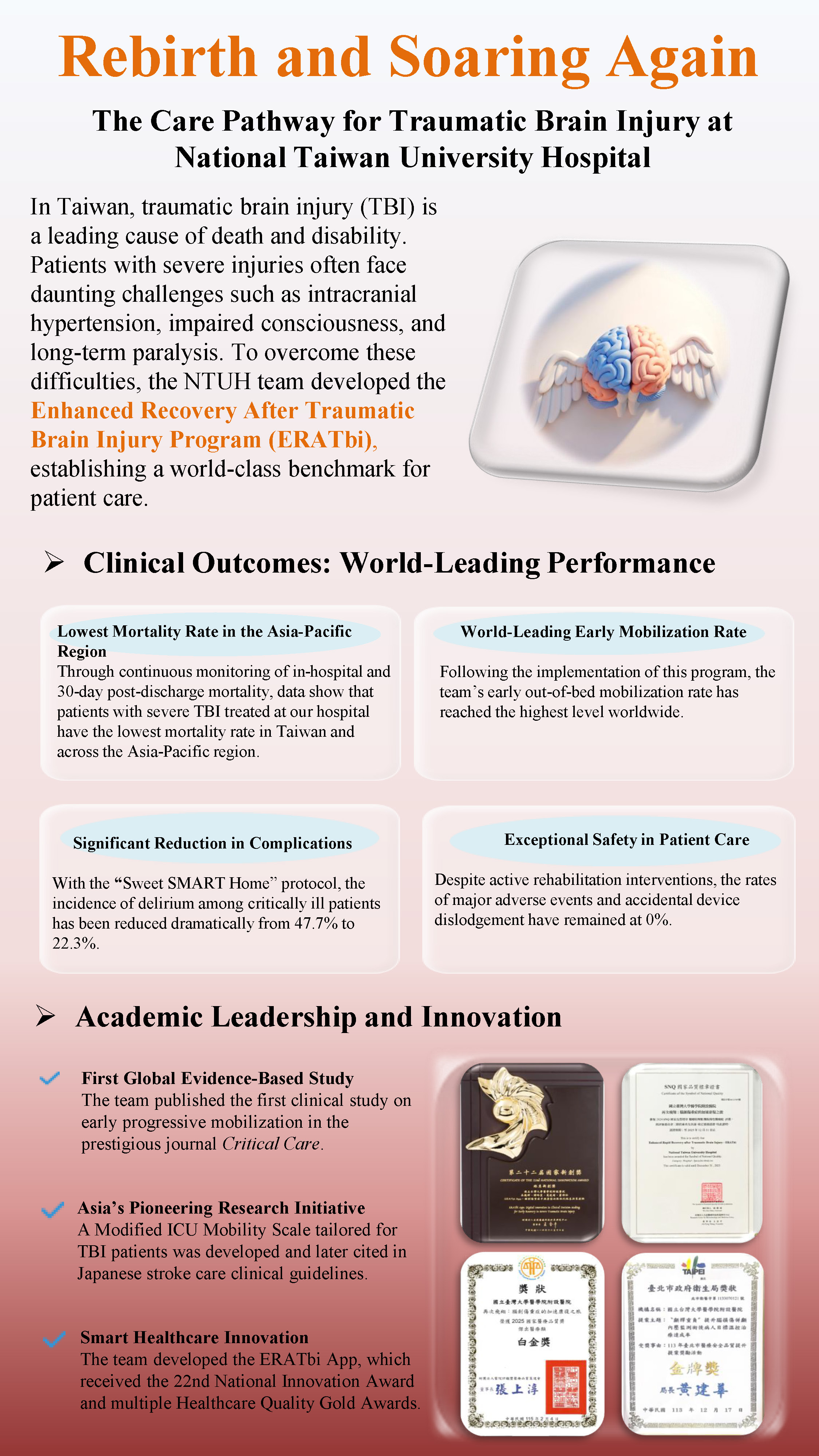
In Taiwan, traumatic brain injury (TBI) is one of the leading causes of death and disability. Patients with severe brain injuries often face critical challenges such as intracranial hypertension, disorders of consciousness, and long-term paralysis. To address these challenges, the Traumatic Brain Injury Team at National Taiwan University Hospital (NTUH) developed the Enhanced Recovery After Traumatic Brain Injury Program (ERATbi). Guided by the core vision of “Soar Again: The Accelerated Recovery Journey for Severe Brain Injury,” the team has established a world-class benchmark for patient care.
1、Clinical Outcomes: World-Leading Performance
NTUH has demonstrated outstanding clinical outcomes in the care of traumatic brain injury patients, surpassing international benchmarks:
• Lowest mortality rate in the Asia-Pacific region
Through continuous monitoring of in-hospital mortality and 30-day post-discharge mortality, data show that NTUH has the lowest mortality rate for severe TBI patients in Taiwan and across the Asia-Pacific region.
• World-leading early mobilization rate
After implementation of the program, the team achieved the highest early out-of-bed mobilization rate worldwide.
• Significant reduction in complications
Through the “Sweet SMART Home” protocol, the incidence of delirium among critically ill patients was reduced from 47.7% to 22.3%.
• Exceptional patient safety
During active rehabilitation interventions, both the major adverse event rate and tube dislodgement rate remained at 0%, ensuring both effectiveness and safety.
2、Academic Leadership and Innovation
Beyond clinical excellence, the team’s academic contributions and research innovations play a key role internationally:
• First global evidence-based study
The team published the world’s first randomized controlled trial on early progressive mobilization in severe TBI patients in the leading journal Critical Care (Impact Factor 15), demonstrating superiority over traditional rehabilitation approaches.
• Pioneering research in Asia
The team published Asia’s first research study on early rehabilitation for severe TBI and developed a modified ICU mobility scale, which has been cited in Japanese stroke care clinical guidelines.
• Smart healthcare innovation
The development of the ERATbi App, integrated with Power BI dashboards for monitoring, received the 22nd National Innovation Award and multiple medical quality gold awards.
3. Care Advantages: Multidisciplinary Integration and Precision Medicine
The team’s core strength lies in the deep integration of multiple specialties to provide a comprehensive, one-stop innovative care model:
• Implementation of ERAS principles
NTUH pioneered the application of Enhanced Recovery After Surgery (ERAS) concepts in severe brain injury care. Nutritional support and early rehabilitation are initiated within 24 hours of patient admission.
• Innovative equipment development
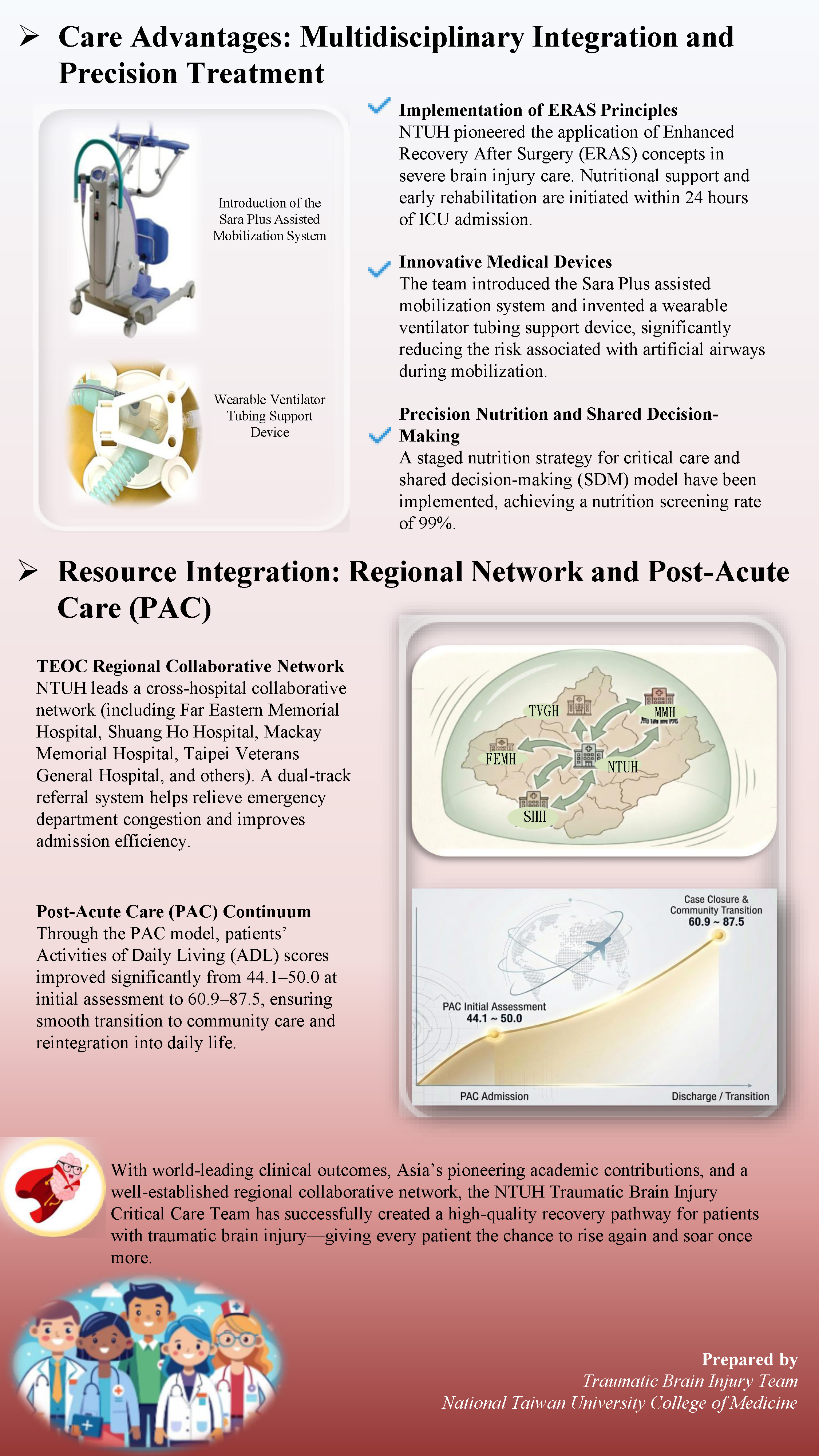
The team introduced the Sara Plus early mobilization device and invented a wearable respiratory tube support device, significantly reducing risks associated with artificial airways during mobilization.
• Precision nutrition and shared decision-making
A critical care nutrition staging strategy and Shared Decision Making (SDM) were implemented, achieving a 99% nutrition screening rate.
4. Resource Integration: Building Regional Trauma Networks and PAC Systems
NTUH not only protects patients within the hospital but also strengthens the resilience of the broader healthcare system:
• Regional Trauma Emergency Operations Center (TEOC)
NTUH leads a cross-hospital integrated network (including Far Eastern Memorial Hospital, Shuang Ho Hospital, Mackay Memorial Hospital, Taipei Veterans General Hospital, and others). Through a dual-track referral system, emergency department congestion is reduced and patient admission efficiency is improved.
• Post-Acute Care (PAC) integration
By promoting the PAC model, patients’ Activities of Daily Living (ADL) scores improved significantly from 44.1–50.0 at initial assessment to 60.9–87.5, ensuring smooth transition to community resources and successful reintegration into daily life.
With world-leading clinical outcomes, Asia-first academic achievements, and a strong regional collaborative care network, the NTUH trauma critical care team has successfully paved a high-quality recovery pathway for patients with traumatic brain injury—giving every patient the opportunity to “soar again.”